
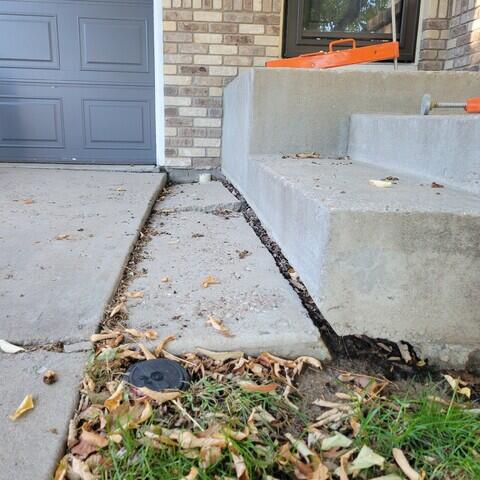
If one slab of your driveway sits lower than the one next to it, you're not imagining things — and you're not alone. Sunken driveway slabs are one of the most common calls we get across Fort Collins, Loveland, Windsor, and Greeley. Here's what's actually happening under your concrete, and what you can do about it before it gets worse.
1. Poorly Compacted Fill Soil
When your home was built, the ground around the foundation was excavated and then backfilled. If that fill soil wasn't compacted properly — and it often isn't, especially in fast-built subdivisions — it settles over the following years. The concrete poured on top settles with it.
This is why driveways, garage aprons, and front walks (all poured over backfill) sink far more often than the street in front of your house, which was built over engineered, compacted road base.
2. Colorado's Expansive Clay Soil
Much of Northern Colorado sits on bentonite-rich clay. This soil swells when wet and shrinks dramatically when dry. Through repeated wet-dry cycles — spring snowmelt followed by bone-dry summers — the soil under your slab expands and contracts, and the slab slowly loses its support.
Clay soil movement is the reason a driveway that was perfect for ten years can start sinking seemingly out of nowhere after one unusually wet spring or dry summer.
3. Water Erosion from Downspouts and Drainage
A downspout that discharges next to your driveway can wash away a surprising amount of soil over a few seasons. The same goes for irrigation overspray and poor lot grading that channels water along slab edges.
Look at where your gutters discharge. If a sunken slab corner lines up with a downspout, you've likely found your culprit. We recommend extending downspouts at least 4-6 feet away from any concrete.
4. Freeze-Thaw Cycles
Northern Colorado sees 100+ freeze-thaw cycles per year — among the highest in the nation. Water under and around your slab freezes, expands, and heaves the concrete. When it thaws, the slab settles back down, but rarely into exactly the same position. Over years, this ratcheting effect leaves slabs tilted and sunken.
5. Voids from Tree Roots and Utility Trenches
Decomposing tree roots leave voids under slabs. So do settling utility trenches — the sewer or water line running under your driveway was backfilled just like your foundation, and it settles the same way.
What To Do About a Sinking Driveway
The good news: a sunken slab almost never needs replacement. Polyurethane foam lifting raises the slab back to its original position by injecting expanding foam through 3/8-inch holes — smaller than a dime. The foam fills the voids, stabilizes the soil, and supports the slab permanently. It cures in about 15 minutes and costs 50-75% less than tearing out and re-pouring.
The one thing you shouldn't do is wait. A slab that's sunk half an inch is a quick, inexpensive lift. A slab that's sunk three inches and cracked into pieces may need replacement. Settlement never reverses on its own — it only accelerates as water finds the newly opened joints.